
Could a missed HMO hazard now cost you £7,000 — or even £40,000?
Routine inspections are an important part of managing an HMO, but there is a big difference between documenting the condition of a room and actually inspecting it for risk.
This has become even more relevant following changes to the Housing Health and Safety Rating System (HHSRS), which came into force on 23 June 2026.
The updated HHSRS is the system used to assess health and safety risks within residential properties. It now covers 21 potential hazards, with the most serious classified as Category 1 hazards. Local authorities are required to take enforcement action where Category 1 hazards are identified.
For landlords, this makes regular and meaningful property inspections increasingly important because there is no compulsory requirement to give you improvement notices like in the past, and can issue fines immediately. The landlord and agent guide can be found here.
An HMO inspection should be more than photographs.
 It is easy for a property inspection to become a photographic exercise.
The room is photographed.
The furniture is recorded.
Any obvious damage is noted.
But some of the most important issues within an HMO aren’t necessarily the most visually obvious ones.
When we inspect an HMO, we’re thinking beyond what the room looks like today.
We’re considering questions such as:
- Are there potential fire or safety concerns?
- Are there signs that maintenance may be required or current maintenance which the tenants have not reported – this is very common.
- Could something develop into a more expensive repair if left unresolved?
- Is there damage that needs documenting? – Important for end-of-tenancy deductions, it can show a deterioration of the items over time and leads to a stronger chance of being able to reclaim.
- Are there changes in how the room appears to be occupied? – Unauthorised pets, hoarding or other potential issues.
- Is there anything that may indicate a wider tenant welfare or property management issue?
That doesn’t mean every small defect represents a serious hazard.
It means somebody needs to know what they’re looking at, what deserves further investigation and what needs acting on.
Why the 2026 HHSRS changes matter to landlords
The HHSRS assesses the potential risk of harm to people occupying a property rather than simply asking whether a particular item passes or fails a checklist. And the financial consequences of serious hazards have also changed.
Councils can now issue civil penalties of up to £7,000 per hazard where a landlord has failed to take reasonably practicable steps to address a serious Category 1 housing hazard. In addition to this, if you fail to remedy the issue or continue to breach the rules, civil penalties of up to £40,000 can also be issued.
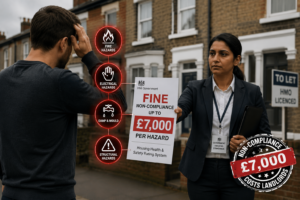 That makes identifying issues early even more valuable. Don’t always assume your tenants will tell you because, in our experience, they won’t, unless it directly affects them, and a tenant not reporting is not an excuse to not deal with a potential hazard.
A developing maintenance problem spotted during an inspection may be relatively straightforward to investigate and resolve.
The same problem left unnoticed for months can become considerably more disruptive — and more expensive.
Who is actually looking at your Manchester HMO?
This is particularly relevant for portfolio landlords and investors who don’t live close to their properties.
You may have contractors, cleaners or tenants regularly visiting the property, but that isn’t the same as having someone walk through it specifically looking at the property from a landlord and management perspective.
A good inspection gives you more than photographs.
It gives you eyes and ears inside the property.
You can get a simple compliance checklist on NRLA.
At Santosha Property Services, we carry out HMO inspections across Manchester for landlords who want someone on the ground who understands the operational, maintenance and management risks associated with shared accommodation.
We identify and document what we see, highlight areas requiring attention and give landlords a clearer picture of what is happening inside their property. You can also find some useful advice covering HMO managers’ duties around common parts, repairs and safety on Shelter.org.
Because when you own an HMO, the question isn’t simply:
“Has somebody inspected it?”
The better question is:
“Did they know what they were looking for?”
Need an HMO inspection in Manchester?
If you own or manage an HMO in Manchester and would like an independent inspection of the property, get in touch with Santosha Property Services.
Send us the property postcode and number of rooms, and we’ll talk you through the inspection service and next steps.